How to Choose a Commercial Ice Machine in 2026: 7 Steps
Buying a commercial ice machine happens once every seven to ten years, which is why a lot of operators make the mistake of matching a machine to their average Tuesday instead of their busiest Saturday. The short answer: calculate your peak demand first, then add 20 percent, pick the ice shape that fits your menu, and compare machines by five year cost of ownership rather than the sticker price. This guide walks through those decisions in seven steps, with the numbers and checklists you need in front of a supplier.
Step 1: Calculate your true daily and peak ice demand
Start with the volume of ice you sell or use, not the size of your building. For most foodservice businesses, the base calculation is simple: average customers per day times ice per customer, plus any process ice for food displays, baking, large events, or bagged ice sales.
Use these numbers as a starting point. They assume cube or nugget ice in a normal portion size, with no unusual process ice needs.
| Business type | Typical daily ice need | What pushes it higher |
|---|---|---|
| Full service restaurant | 375 to 600 lb | Banquet nights, outdoor patio seating |
| Fast casual restaurant | 700 to 1,200 lb | High volume drive through, combo meals |
| Cocktail bar | 450 to 750 lb | Live music nights, frozen drinks |
| Coffee shop | 300 to 500 lb | Iced drinks in summer, refill cups |
| Hotel | 1,000 to 2,000 lb | Banquets, poolside service, weddings |
| Hospital cafeteria | 400 to 800 lb | Meal trays, patient floor ice |
| Food truck | 200 to 400 lb | Compact machines, limited storage |
| Convenience store | 250 to 500 lb | Bagged ice sales, fountain drinks |
| Catering kitchen | 500 to 900 lb | Event chafing dishes, drink stations |
For a per customer estimate, full service restaurants usually run 1.5 to 2 lb per diner, fast casual runs 2 to 3 lb, and cocktail bars run 3 to 5 lb per guest when ice goes into every drink. Smoothie shops and bubble tea places can hit 4 to 6 lb per customer because blended drinks use a lot of ice.
The formula we recommend for a single location: (customers per day times ice per customer) plus (process ice per day) plus (bagged ice per day) equals base demand. Multiply base demand by 1.2 for peak days and planned growth.
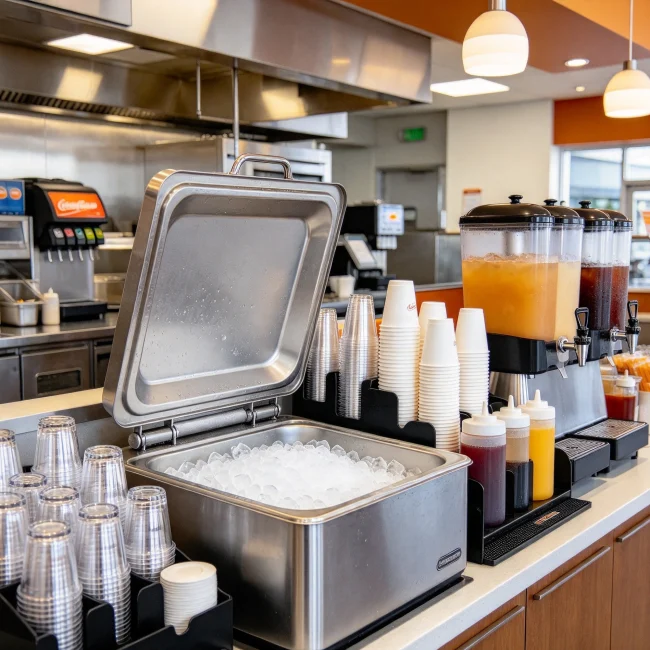
Worked example: A fast casual restaurant serves 200 customers a day. At 2.5 lb per customer, base demand is 500 lb. Add 20 percent for peak days and you get 600 lb. That means the machine should make at least 600 lb per 24 hours, and the bin should hold around 720 lb so the restaurant does not run out before the lunch rush ends.
Step 2: Choose the ice type your operation actually needs
Ice shape affects drink quality, food presentation, melt rate, and operating cost. The machine you choose has to make the shape your menu depends on.
| Ice type | Best for | Melt rate | Energy per 100 lb | Typical price for 300 to 600 lb machine |
|---|---|---|---|---|
| Full cube | Cocktail bars, upscale restaurants | Slow | 5 to 8 kWh | $3,000 to $8,000 |
| Half cube | Fast casual, quick service, soda fountains | Moderate | 4 to 7 kWh | $2,500 to $7,000 |
| Nugget | Healthcare, smoothie shops, iced coffee | Fastest | 5 to 9 kWh | $3,000 to $9,000 |
| Flake | Seafood displays, grocery, medical | Slow | 5 to 9 kWh | $3,500 to $9,500 |
| Crushed | Blended drinks, food displays | Fast | 4 to 8 kWh | $3,000 to $8,000 |
Full cube ice is clear and hard, so it dilutes cocktails less. Nugget ice is soft and chewy, which makes it popular for iced coffee and hospital water cups. Flake ice packs around fish better than cubes. If your menu is mostly fountain drinks, half cube or nugget will keep customers happy without the premium price of full cube.
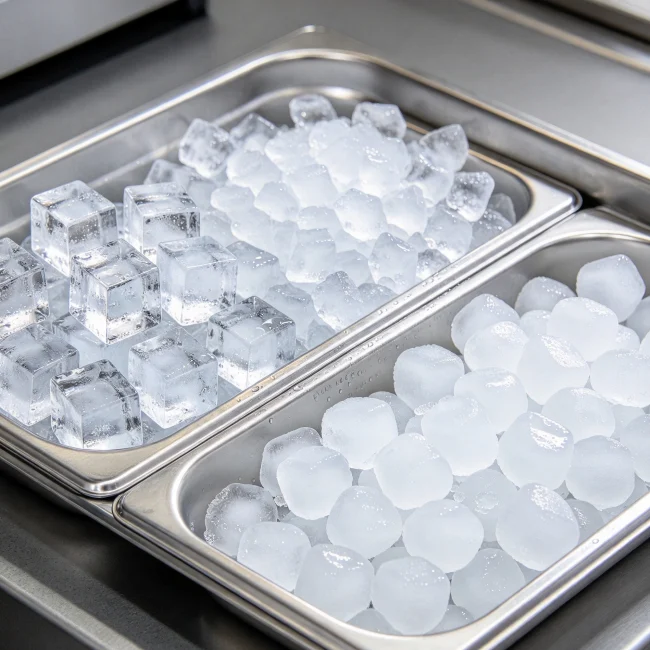
Some machines can switch between full cube and half cube, but most make one shape only. If you are not sure what your customers expect, ask three suppliers what their most popular shape is in your area, then test the ice in your drinks before you sign.
Step 3: Pick the machine configuration that fits your space
Commercial ice machines come in four main configurations. The right one depends on floor space, ceiling height, and whether customers take ice directly from the machine.
| Configuration | Daily capacity | Typical use | What to know |
|---|---|---|---|
| Self contained undercounter | 50 to 250 lb | Small bars, cafes | Built in storage, compact, limited output |
| Countertop | 30 to 100 lb | Coffee shops, small servers | Sits on a counter, feeds a separate dispenser or bin |
| Modular head with separate bin | 200 to 1,000 lb | Restaurants, hotels, catering | Most flexible, larger footprint, needs a bin |
| Ice dispenser | 100 to 1,000 lb | Hotels, cafeterias, self service | Customer facing, more moving parts, better hygiene |
Measure the space before you shop. Most modular heads need 24 to 30 in of clearance at the top for service, and at least 6 in behind the unit for air flow. Air-cooled machines blow heat into the room, so a small, closed kitchen can get uncomfortably hot in summer. Water-cooled or remote-cooled units get that heat out of the building, but they cost more to install.
Step 4: Match capacity with the right derating and bin size
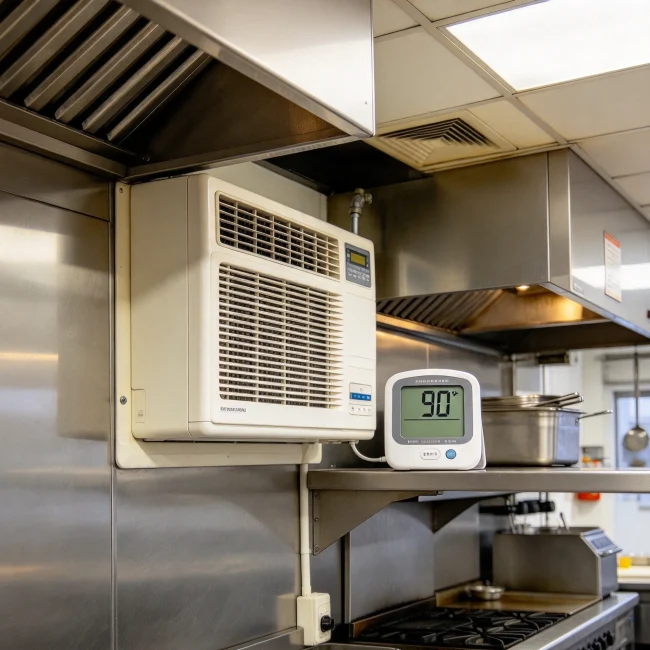
Ice machine capacity is rated under ideal conditions, usually 90 degrees Fahrenheit air and 70 degrees water. In a real kitchen, especially near a stove or in a hot climate, production can drop 15 to 20 percent.
Check the rating condition on the spec sheet. If a machine says 500 lb per day at 90/70 and your kitchen sits at 95 degrees for four months, expect closer to 425 lb on those days.
The bin matters as much as the machine. A 600 lb machine paired with a 200 lb bin will still run out before a busy dinner service. A good rule is to size the bin to at least half your peak daily production, and add 20 percent if you store ice overnight or use it for catering. If you bag ice for events, go even larger.
Step 5: Compare cooling systems before you sign the quote
The biggest decision in a commercial ice machine is how it rejects heat, not which brand you pick. Air-cooled, water-cooled, remote-cooled, and evaporative units each behave differently in a real kitchen.
| Cooling type | How it works | Electricity use | Water use | Heat in kitchen | Best situation |
|---|---|---|---|---|---|
| Air cooled | Fan blows across condenser coils | Moderate | Low | High | Standard kitchen under 80 degrees |
| Water cooled | Water carries heat to a drain | Moderate | High | Low | Hot kitchens with good water supply |
| Remote cooled | Heat moves to an outside condenser | Low | Low | Low | Kitchens near an outside wall or roof |
| Evaporative | Air and water spray cool the condenser | Low | Medium | Low | Dry climates with water treatment |
Air-cooled units put the most heat back into the kitchen. Water-cooled units need a steady water supply and a drain, so they cost more to run where water is expensive. Remote-cooled units move heat to an outside condenser, which keeps the kitchen cooler and production stable in hot climates. Evaporative condensers use outside air and water spray, which works well in dry regions but needs regular descaling.
Step 6: Run the five year cost of ownership numbers
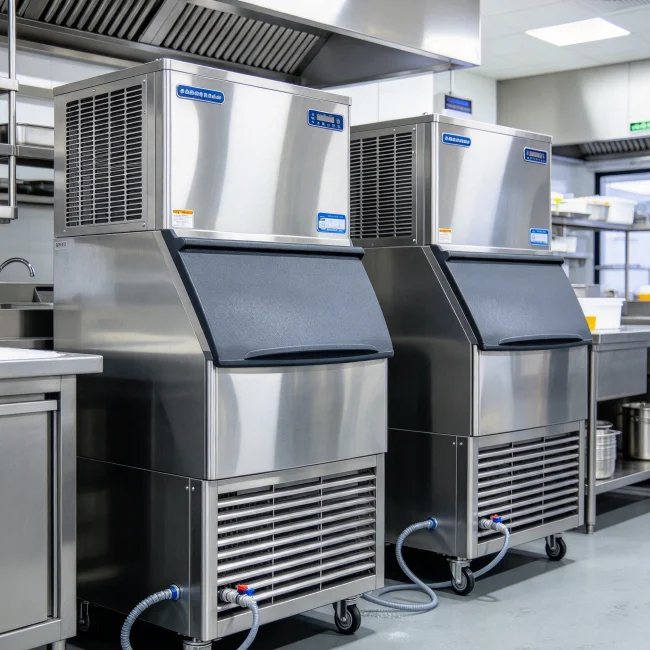
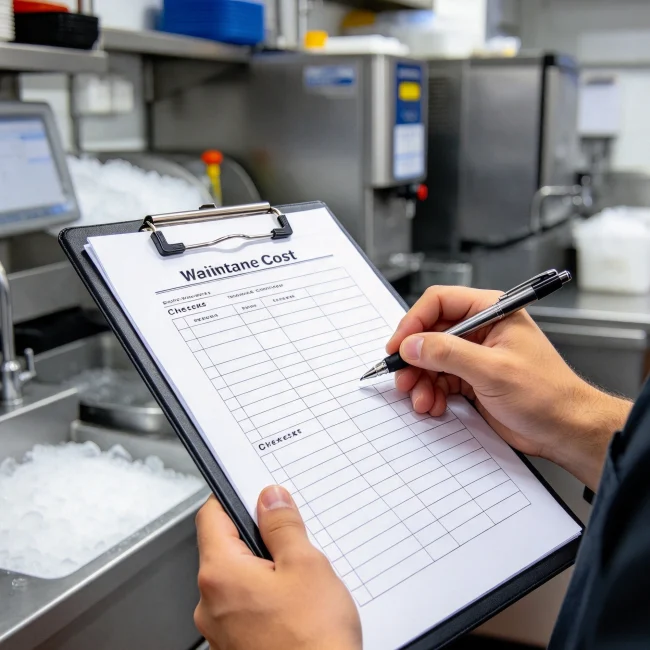
The cheapest quote is usually the most expensive machine by year three. You need to compare purchase price, installation, electricity, water, filters, cleaning labor, and likely repairs over five years.
Here is a realistic breakdown for a 500 lb per day modular system in 2026, using an air-cooled unit and average U.S. utility rates.
| Cost category | Year one | Years two through five |
|---|---|---|
| Purchase price | $5,000 | $0 |
| Installation includes electric, water, drain, venting | $1,200 | $0 |
| Electricity at 25 kWh per day, $0.15 per kWh | $1,370 | $5,480 |
| Water, sewer, and filters | $700 | $2,800 |
| Cleaning labor, 30 minutes weekly at $20 per hour | $520 | $2,080 |
| Preventive maintenance and minor repairs | $200 | $1,200 |
| Five year total | $8,990 | $11,560 |
That 500 lb system costs about $20,500 over five years. If your electric rate is higher or your water is hard enough to need a softener, the number goes up. Run your local utility rates before you compare quotes, and ask about ENERGY STAR certified models. The certification usually means a bigger upfront discount is available through utility rebates.
Leasing lowers the upfront payment and bundles service, which is attractive for a business with cash flow limits. Buying works out cheaper after three to five years when you have warranty coverage and a service company you trust. Compare both with your accountant before signing a long term agreement.
Step 7: Plan for water, sanitation, service, and compliance
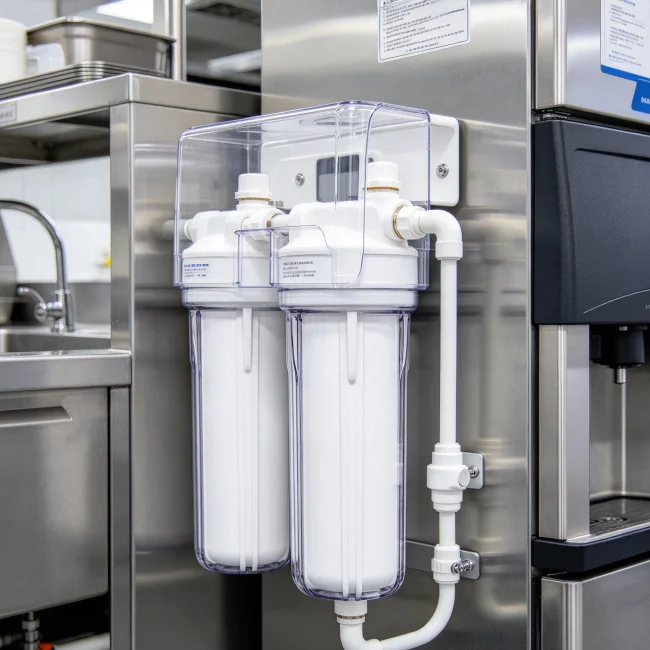
Most early ice machine failures come from water, not the compressor. Hard water creates scale on the evaporator, which makes the machine run longer and produce less ice. Have your water tested before you choose filtration. A basic carbon filter removes chlorine and taste, but if your water is hard, add a scale inhibitor or a softener.
If you serve the public, the health inspector will look at the machine’s air gap, the drain line, and whether the bin lid closes completely. Ice that touches food must be made in a machine certified to NSF/ANSI 12. Ask for the certificate before you buy, not just a brochure line.
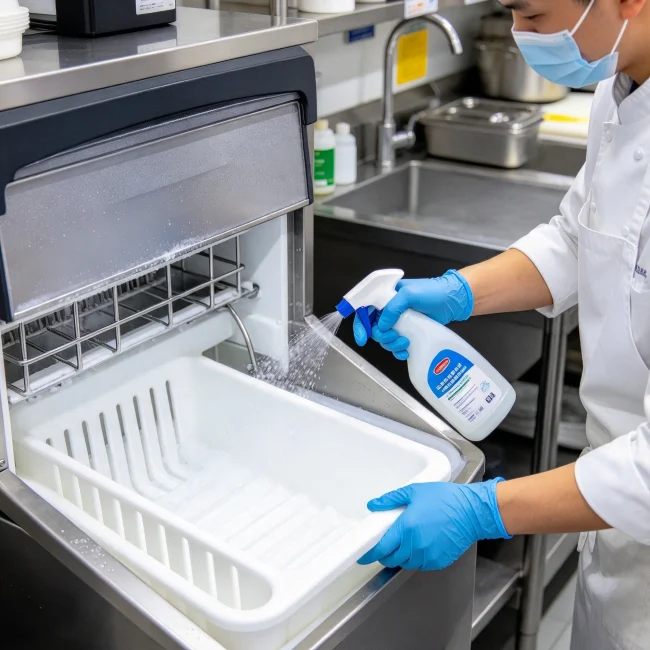
Follow a simple cleaning schedule and keep a log. Here is what most operators need:
| Frequency | What to do |
|---|---|
| Daily | Check ice level, wipe the exterior, clear any slush in the bin |
| Weekly | Clean the bin with approved sanitizer, check the drain line |
| Monthly | Clean condenser coils, inspect water filter pressure, check ice thickness |
| Quarterly | Deep clean bin and evaporator, replace water filter, test sanitizer |
| Yearly | Full preventive maintenance by a technician, replace seals, check remote lines |
Service matters more than the brand sticker. Ask the dealer these questions before you commit:
- How long does a replacement evaporator or compressor take to arrive?
- Does the warranty cover labor after the first 90 days?
- Is there a local technician who stocks parts for this model the same week?
- Does the quote include installation, startup, and a water test?
Put the steps to work: three quick scenarios
Scenario 1: A 150 seat restaurant with a popular patio does 250 covers on a Saturday night. At 2 lb per cover, that is 500 lb. Add 20 percent for peak and the machine needs to make 600 lb per day. A modular head with a 700 lb bin, air-cooled, makes sense if the kitchen has decent airflow. If the kitchen runs hot, choose remote-cooled instead.
Scenario 2: A cocktail bar does 300 customers on a Friday. At 4 lb per customer, that is 1,200 lb. The bar serves premium cocktails, so full cube ice is the right shape. A machine that makes 1,400 lb per day with a water-cooled condenser fits a small bar with no outside wall, but water costs need checking.
Scenario 3: A hospital kitchen makes soft food and needs ice for patient trays. Nugget ice is easier to chew and keeps cold well. At 500 patients and visitors per day, with 2 lb per tray, base demand is 1,000 lb. Add 20 percent, then choose a machine with remote cooling if the equipment room sits above 85 degrees.
Six buying mistakes that cost operators real money
- Buying for the average day instead of the peak day.
- Choosing the cheapest quote and ignoring five year energy and water costs.
- Using a bin too small for the machine’s daily output.
- Skipping a water test and installing only a basic filter.
- Ignoring heat rejection in an enclosed kitchen.
- Waiting for the warranty to start before confirming service coverage.
Before you sign the quote
Run the numbers for your own operation, not a generic chart. Ask for a water test, a load calculation, and a written service plan. A machine that makes enough ice on your worst day, uses water and electricity efficiently, and is easy to clean will pay for itself. The cheapest machine usually costs the most by year five.
FAQ
How much ice does a restaurant need per customer?
Full service restaurants typically run 1.5 to 2 lb per diner. Fast casual operations run 2 to 3 lb. Cocktail bars and smoothie shops can run 3 to 5 lb per customer because every drink is heavily iced.
How long do commercial ice machines last?
With regular cleaning and water treatment, a good machine lasts 10 to 15 years. The compressor often passes 10 years, while the evaporator and bin door seals may need replacing sooner.
Is a water-cooled ice machine worth it?
It depends on your local water rate and your kitchen temperature. Water-cooled units keep the kitchen cooler and production stable in hot rooms, but they can cost several hundred dollars extra per year in water and sewer charges.
Do I need an NSF certified ice machine?
If you sell food or drink to the public, yes. NSF/ANSI 12 certification means the machine is built to clean easily and meet health code requirements. Ask for the certificate before you buy.
How often should I clean a commercial ice machine?
Clean the bin weekly and deep clean the evaporator monthly or quarterly, depending on water hardness. Every machine has a manufacturer cycle. Follow it and keep a cleaning log for health inspectors.
Should I lease or buy a commercial ice machine?
Leasing lowers upfront costs and usually includes maintenance. Buying works out cheaper after three to five years if you have warranty coverage and a local service company. Compare both options with your accountant before signing a long term agreement.